Simulator setup
What the Simulator Actually Models
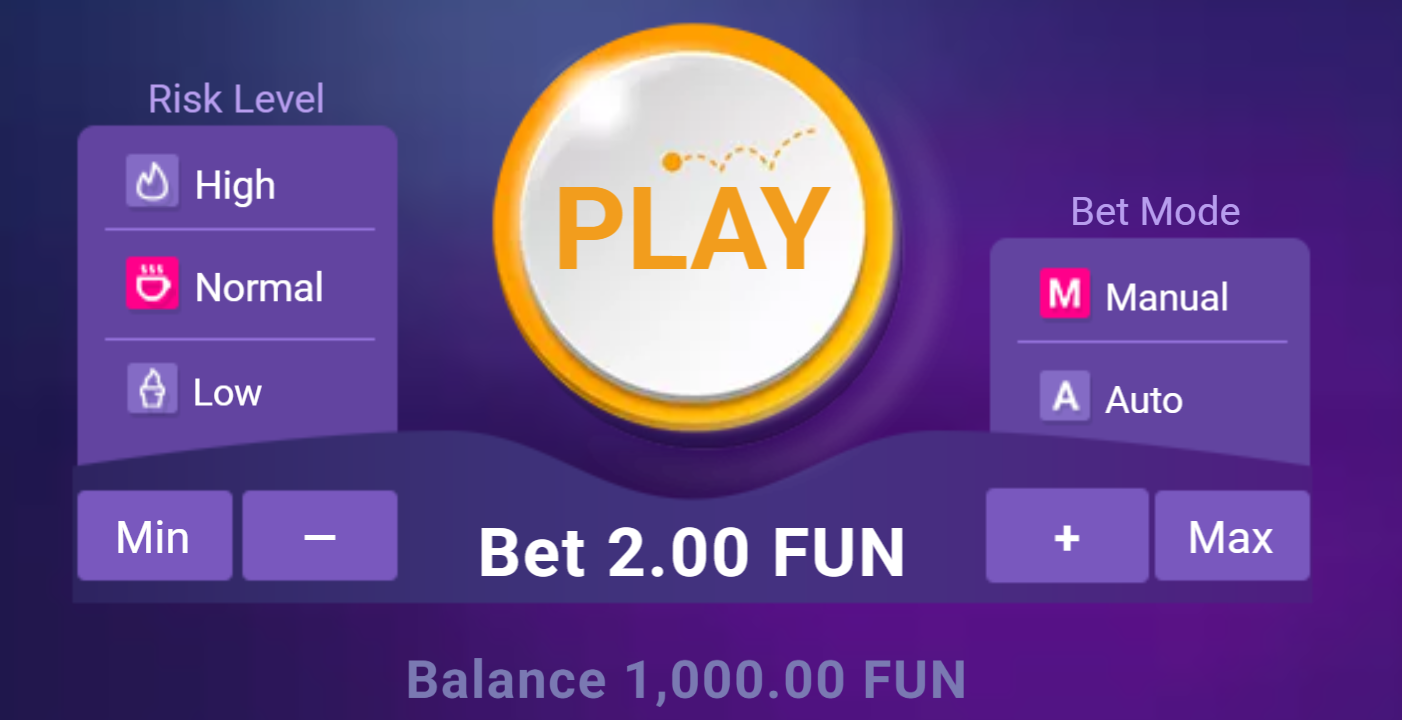
The simulator replays outcomes from BGaming Original Plinko with 16 rows, using recorded sequences of drops. Three risk samples are available: low, medium (shown as Normal in the game interface) and high, each built from exactly 1000 drops at a fixed stake of 1 FUN. Because everyone replays the same recorded sequence, anyone running the same configuration gets identical results, which makes comparisons reproducible and discussions meaningful.
The model is not the provider demo and it is not a forecast. A public BGaming demo tells you nothing about availability through a Dutch licensed operator, and a simulated sequence tells you nothing about your next session. It is a controlled environment for asking: if this exact sequence of pockets had occurred, how would each staking rule have behaved? That is a useful question, but it stays hypothetical.
Setting Up a Run: Bank, Base, Cap and Percentage
A typical workflow starts with the ordinary bank of 1000 FUN and a stake cap of 100 FUN. You then pick one of the fourteen candidates and let the simulator settle each drop against the sequence. The settings panel exposes bank, base stake, cap, percentage and stop limits, and every run can be exported as CSV for your own spreadsheet checks.
Two worked examples show why configuration details matter. Example one: bank 1000, Percentage rule at 1%. The first stake is 10 FUN, not 1, because the percentage applies to the current bank. After a losing drop that pays 0.3x at Normal risk, 3 FUN comes back, the bank falls to 993 and the next stake is 9, because the rule floors the stake to whole FUN credits. Example two: bank 500, Capped Martingale with base 1. The rule doubles after each loss and resets after the fifth consecutive loss, so a full losing cycle stakes 1+2+4+8+16 = 31 FUN before returns, not 15. That is a cycle limit, not a guaranteed loss cap, because partial payouts below stake still count as losses and erode the bank between cycles.
Rules and strategies
The Core Staking Rules and Their Exact Semantics
Each rule has precise definitions, and misunderstanding them is the most common reading error. A loss means the payout is below the stake; a profit means it is above; a break-even payout holds the progression where it is. This matters because Plinko pays partial returns constantly: the centre pocket pays 0.3x at Normal, 0.5x at low and 0.2x at high risk, so a return can still be a net loss. At 16 rows the theoretical net-loss frequency is about 19.64% on Low and 54.55% on Normal; do not apply one risk level’s frequency to another. Eight core staking rules are defined below; the wider candidate set of fourteen also includes stop-limit presets, restart presets, frozen pattern rules and sensitivity checks.
- Martingale doubles after a loss and resets after a profitable result; because partial payouts are common, the classic 2x recovery assumption is invalid.
- Capped Martingale behaves like Martingale but resets after the fifth consecutive loss, having doubled four times through stakes 1, 2, 4, 8 and 16.
- Percentage stakes a fixed share of the current bank, floored to whole FUN with a minimum of 1 and a cap of 100, so stakes shrink during drawdowns.
- D’Alembert adds one unit after a loss and subtracts one after a profit, never below the base.
- Fibonacci advances one step after a loss and moves two steps back after a profit.
- Paroli doubles after wins and resets after three winning steps or any loss.
- 1-3-2-6 progresses through that sequence after wins and resets after any loss.
- Fixed stake never changes, providing the baseline every other rule is compared against.
Fixed Pattern Candidates and Why They Are Frozen
Four pattern candidates were defined in advance and are tested unchanged on fresh data, which is the only honest way to evaluate a pattern. Pattern A100 triggers when the previous five pocket distances show 1–2, then 3 or more, then 1–2, 1–2, then 3 or more; it places one 100 FUN stake followed by eight ordinary paid 1 FUN drops. B50 and B100 trigger on three previous distances of 4 or more, then exactly 1, then exactly 1, placing one 50 or 100 FUN stake plus three ordinary paid drops. C25 triggers when the previous 16 pockets contain at most one exact centre, placing one 25 FUN stake plus three ordinary drops.
Freezing the definitions before testing prevents the classic trap of fitting a pattern to data you have already seen. The odds reference page shows why patience is required. Hitting either edge pocket on 16 rows has probability 1 in 32768 per drop. The probability of at least one hit in N drops is 1-(1-p)^N. So even thousands of drops can pass without the 1000x high-risk edge appearing.
Reading the results
Reading Outputs: Early Stop, Overshoot and Restart
The chart plots bank after each settled drop, and the CSV logs every stake, payout, net change and rule state. Stop limits check the settled net result against -20 and +20. Two behaviours surprise new users. First, overshoot: because the check happens after settlement, a single drop can push the net from -15 to -40, so the stop triggers beyond its nominal line. Second, restart: restarting after a stop resets only the cycle reference point, not the bank. Your remaining bankroll carries over and all subsequent drops remain paid drops. This directly answers a common Dutch question: opnieuw starten verandert je saldo niet.
Interpreting results requires discipline. A positive run means the rule happened to suit that sequence; on a different sequence it may invert. A negative run does not prove a rule is uniquely bad either, because all rules face the same negative expectation embedded in the payout table. What you can legitimately compare is shape: drawdown depth, stake escalation speed, time to stop, and sensitivity to the 100 FUN cap. The results module presents the actual measured outcomes separately; this article deliberately invents none. For concreteness, on the recorded low-risk sample the B100 pattern rule finished all 1000 drops with a net of +96.7 FUN from a 1000 FUN start (turnover 1891, max drawdown 52.6). The same rule gained +276.8 on medium risk and +542.6 on high risk. Capped Martingale with base 1 and four doubling steps gained +523.5 FUN on medium risk (max drawdown 196, 49 restarts) and +725.6 on high risk (max drawdown 478.8), but lost 9.6 on low risk. These were the largest nets among the 14 predefined rules, selected after seeing all outcomes on the full history. A held-out check of a training-selected B50 configuration over the final 300 drops gave +6.6 on low, -37.5 on medium and +233.2 on high risk. Historical fits cannot establish future profitability, and because turnover differs between rules, absolute profits are not a normalized performance ranking.
Limits of the tool
Dutch Context and Sensible Use
Dutch players should note that the Kansspelautoriteit reported removing 20 illegal gambling apps from stores since the start of 2025, some using Plinko-style advertising to redirect to illegal sites. An app with Plinko in the name is not the same as the demo, and game identity must be checked before reusing any payout table.
Use the simulator as a rehearsal space: test small-bank sensitivity and try the held-out suffix approach by validating a parameter choice on data it was not tuned on. Treat every EUR figure you might mentally attach as explicitly hypothetical, since the tool runs in FUN credits only. If you later explore real play via the /play/ option, availability through a licensed Dutch operator remains unverified and no simulator result guarantees profitability.
Want to test a Plinko predictor idea? Record probabilities before revealing fresh model drops in the probability and forecast trainer.
Plinko questions answered
Does restarting after a stop limit reset my balance?
No. Restart resets only the cycle reference point. Your remaining bank carries over and every subsequent drop is still a paid drop.
Why did the stop trigger beyond -20 or +20?
Stops are checked after each drop settles. A single drop can move net from -15 to -40, so the stop fires with overshoot past the nominal line.
Can the simulator predict my real Plinko results?
No. It replays recorded or seeded FUN sequences to show how rules behave mechanically. It is not the provider demo and cannot forecast real outcomes.
Why does Martingale fail to recover losses in the simulation?
Because most Plinko payouts are partial returns below stake. Doubling assumes a win pays at least 2x, but centre pockets pay 0.2x to 0.5x, so doubling often just accelerates losses.