
Game and version
What this demo actually is
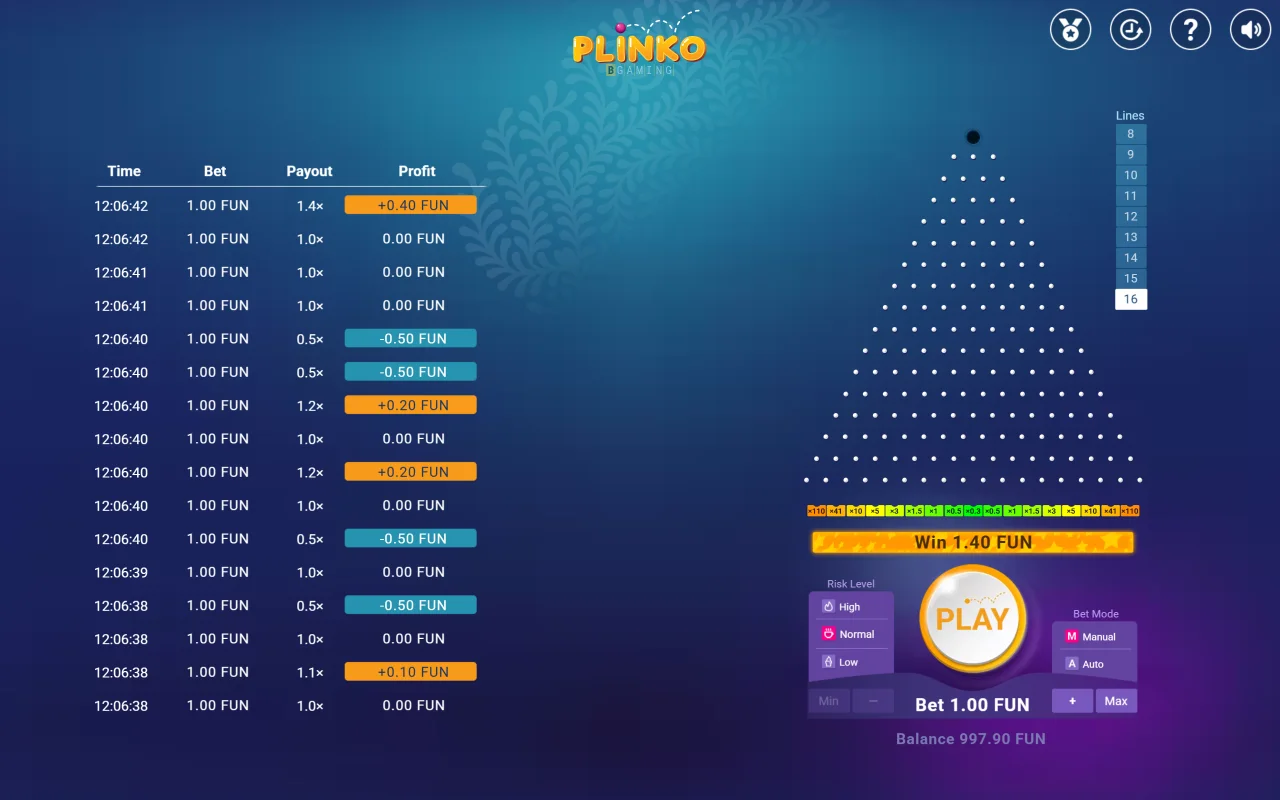
The embedded game is BGaming Original Plinko, the provider’s own free-play build, delivered through an official iframe. It presents the provider’s Plinko mathematics and interface in demo form, but the balance is denominated in FUN, a virtual currency with no monetary value. You cannot deposit, win, or withdraw anything here; a big multiplier simply raises a number on a practice ledger.
Do not confuse this provider demo with our separate random-model simulator, which is a teaching tool that imitates Plinko-style physics for testing progressions at speed. The simulator is useful for bulk experiments; the iframe on this page is the genuine article. If you want the practice engine instead, use our random-model Plinko simulator and treat its output as model data, not provider data.
Loading the iframe and the fallback
For privacy and performance, the game does not auto-load. Press the load button and the iframe initialises on demand; until then no third-party content runs. If the provider frame fails to appear, an open-provider fallback link takes you to the same demo hosted by BGaming directly, so you are never locked out of practice.
Troubleshooting is ordinary browser hygiene, never circumvention: allow third-party content for this page, disable aggressive script blockers for the session, clear cached data if the frame stalls, try another modern browser, and rotate your phone if the layout is cramped. We do not advise VPNs, mirror hunting, or bypassing any regional block; if the demo is unavailable to you, that restriction stands.
Stakes and controls
Every control, explained once
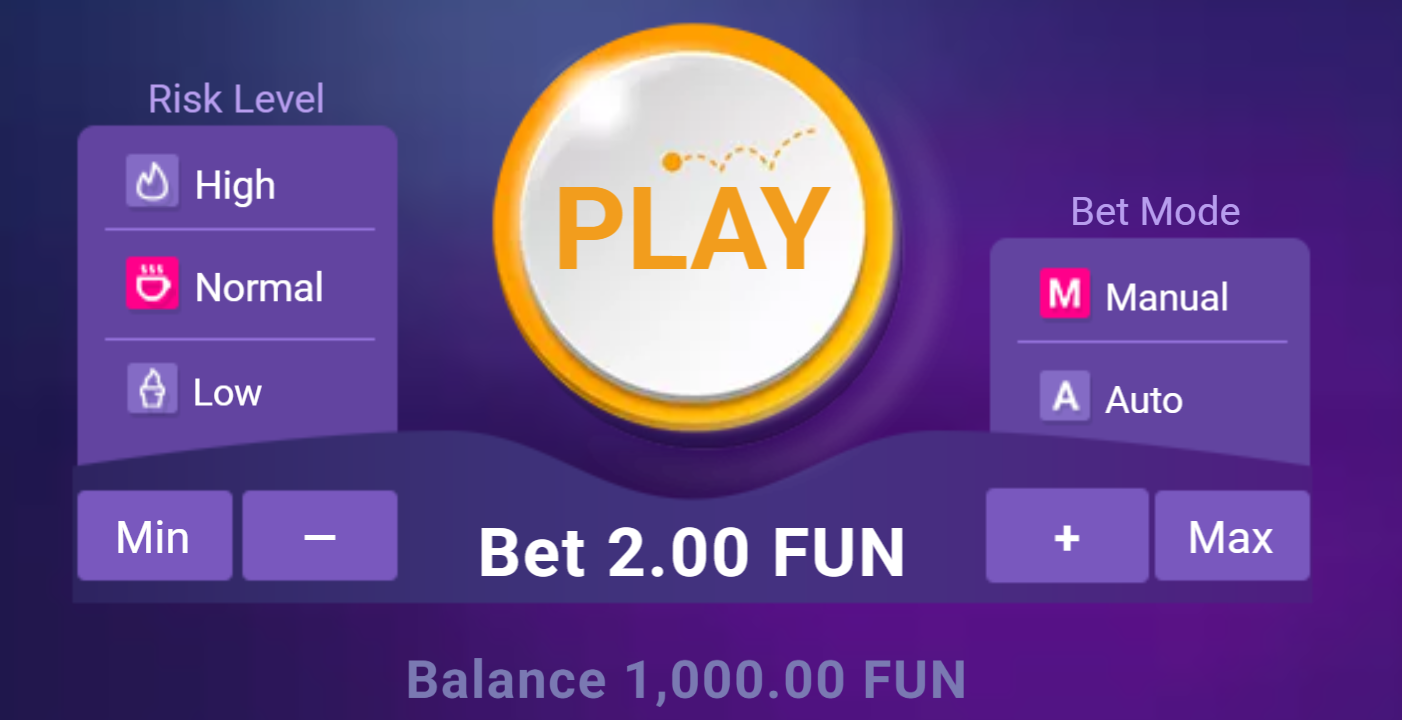
The demo offers 8 to 16 rows of pins; more rows widen the payout spread and push the big multipliers further to the edges. Three risk levels are available: low, medium (labelled Normal in the interface), and high. Stake controls set the bet per ball, and you choose between Manual mode, where each click drops one ball, and Auto mode, which runs a configured sequence of drops at a fixed stake and stops on your limits.
Reading a settled payout is easy to get wrong. After the ball lands, the game shows the multiplier of the pocket and credits stake times multiplier. A result below your stake is a loss even though money came back; for example, on Normal risk the centre pocket pays 0.3 times, so a 1 FUN drop returns 0.30 FUN and settles as a 0.70 FUN loss. On low risk the centre pays 0.5 times; on high risk only 0.2 times, while the extreme edge pocket reaches 1000 times.
Practice and examples
A short practice worksheet
Use the demo deliberately rather than clicking at random. A twenty-minute session is enough to learn the interface and gather honest notes before you touch any staking system.
Work through these steps in order and write the answers down; they become the baseline for everything you test later in our Plinko settings guide and Plinko strategy overview.
- Drop 20 balls on 16 rows, low risk, Manual mode, and record how many settle below stake.
- Repeat on Normal and on high risk; note how the centre multiplier changes (0.5, 0.3, 0.2) and how that shifts your session balance.
- Run one Auto sequence of 25 drops at a fixed stake and compare the final balance with your Manual sessions.
- Set 8 rows, then 12, then 16, and observe how often balls reach the outer pockets; the theoretical chance of either edge on 16 rows is 1 in 32768, so absence of edge hits is expected, not a bug.
- Practise reading three settled payouts aloud: stake, multiplier, return, net.
Where to go next
Once the controls are familiar, the natural next step is structured testing. Our strategy pages define each system precisely. Martingale doubles after a loss and resets after any net-positive result, while break-even results hold the progression. Partial payouts break the naive 2x recovery assumption. Capped Martingale doubles for at most four steps (stakes 1, 2, 4, 8 and 16 FUN) and resets after the fifth consecutive net loss or any net-positive result. Percentage staking starts at 1% of bank, so at a 1000 FUN bank the first stake is 10 FUN, not 1. D’Alembert, Fibonacci, Paroli, and 1-3-2-6 each have their own reset rules, and stop limits check settled net against minus 20 or plus 20 and can overshoot.
Restarting after a stop limit resets only the cycle reference: your remaining bank and every subsequent paid drop carry over, so a restart is not a refund. When you are ready to compare theory with observation, our recorded Plinko test results are published in a separate evidence module, and the Plinko odds and multipliers page derives the waiting times behind rare pockets. If you later choose to play for real, the prominently marked play button is a commercial affiliate link whose availability we have not verified; the demo here remains free and FUN-only.
Mobile play
Playing on a phone
On mobile, the demo runs in the browser; there is nothing to install. Landscape orientation gives the pyramid more horizontal room, and your browser’s fullscreen control hides the address bar for extra vertical space. These are standard browser features available to you, not claims about specific handsets: we have not tested individual devices, so treat orientation and fullscreen as tools to try rather than guarantees about your model.
If the frame feels slow on mobile data, load it once and avoid refreshing, since each refresh re-fetches the game assets. Auto mode is convenient on a small screen because it removes repetitive tapping, but set a drop count you can supervise rather than letting long sequences run unattended.
A note for players in the Netherlands
Dutch players should know that the Kansspelautoriteit reported removing 20 illegal gambling apps from stores since the start of 2025, some using Plinko-style advertising to funnel users to illegal sites. An app with Plinko in the name is not necessarily this game, and a public BGaming demo does not prove availability through a Dutch licensed operator. Always verify which version and which operator you are actually dealing with before playing for money.
Compare and test
Do you need a Plinko app or APK to practise?
No download is needed for the BGaming browser demo on this page. Press the demo button to load the provider’s game, then choose your rows, risk and virtual stake. Our separate Plinko simulator runs calculations on recorded rows or a labelled random model. Neither tool creates a cash account or pays out FUN credits.
A search for ‘Plinko app’ can refer to an operator app, a free game or an unrelated rewards product. Identify the publisher, balance units and withdrawal terms before treating an on-screen number as money. Installing an APK does not unlock a winning strategy. A predictor or signal cannot be validated by a few selected screenshots.
We have not verified ‘Plinko Space – Play and Win’ as the same product as this BGaming demo, or confirmed its payment claims. Roblox codes and Limbo strategies likewise concern other products. This page supplies no download, login or withdrawal service for them. Use the visible provider name and controls to check which game you have opened.
Want to test a Plinko predictor idea? Record probabilities before revealing fresh model drops in the probability and forecast trainer.
Plinko questions answered
Is this the real BGaming Plinko or a copy?
The iframe loads the official BGaming Original Plinko demo. Our separate simulator is a random-model teaching tool and is clearly labelled as such.
Can I win or withdraw real money from the demo?
No. The balance is virtual FUN with no monetary value. There are no deposits, prizes, or withdrawals of any kind.
Why did nothing load when I opened the page?
By design the game loads only after you press the button. If it still fails, use the open-provider fallback link or adjust standard browser settings such as script blocking and cache.
What is the difference between Manual and Auto mode?
Manual drops one ball per click. Auto runs a configured number of drops at a fixed stake and stops at your set limits.
Does restarting after a stop limit restore my balance?
No. Restart resets only the cycle reference; your remaining bank and all later paid drops continue as they were.
Which risk level should I practise on first?
Start on low risk with 16 rows to see frequent partial returns, then compare Normal and high to understand how centre multipliers of 0.5, 0.3, and 0.2 change session behaviour.