Game and version
Which Plinko game this guide covers
Plinko is not one single game. Several providers publish their own versions, and they differ in row counts, multipliers, risk labels and even how the stake is entered. This guide covers the BGaming Original Plinko version specifically: a vertical board of pegs, a ball dropped from the top, and a row of multiplier pockets along the bottom. Before you reuse any payout table, strategy note or odds figure, confirm that the game in front of you is actually this version. The practical check is simple: open the game info or paytable panel and look for the provider name BGaming, then compare the row options and the multiplier row against what this guide describes.
A Dutch forum discussion asking which Plinko variant is preferable illustrates why this matters: two games can both be called Plinko while paying very differently at the centre and the edges. In the BGaming version covered here, the centre pocket on Normal risk pays 0.3x, on Low risk 0.5x, and on High risk 0.2x, while the far edge pocket on High risk reaches 1000x. If the numbers on your screen do not match, you are looking at a different product and none of the arithmetic below applies. Our odds and payout reference is written for this exact configuration, and the free demo lets you confirm the identity of the game without spending anything.
The board, the ball and the pockets
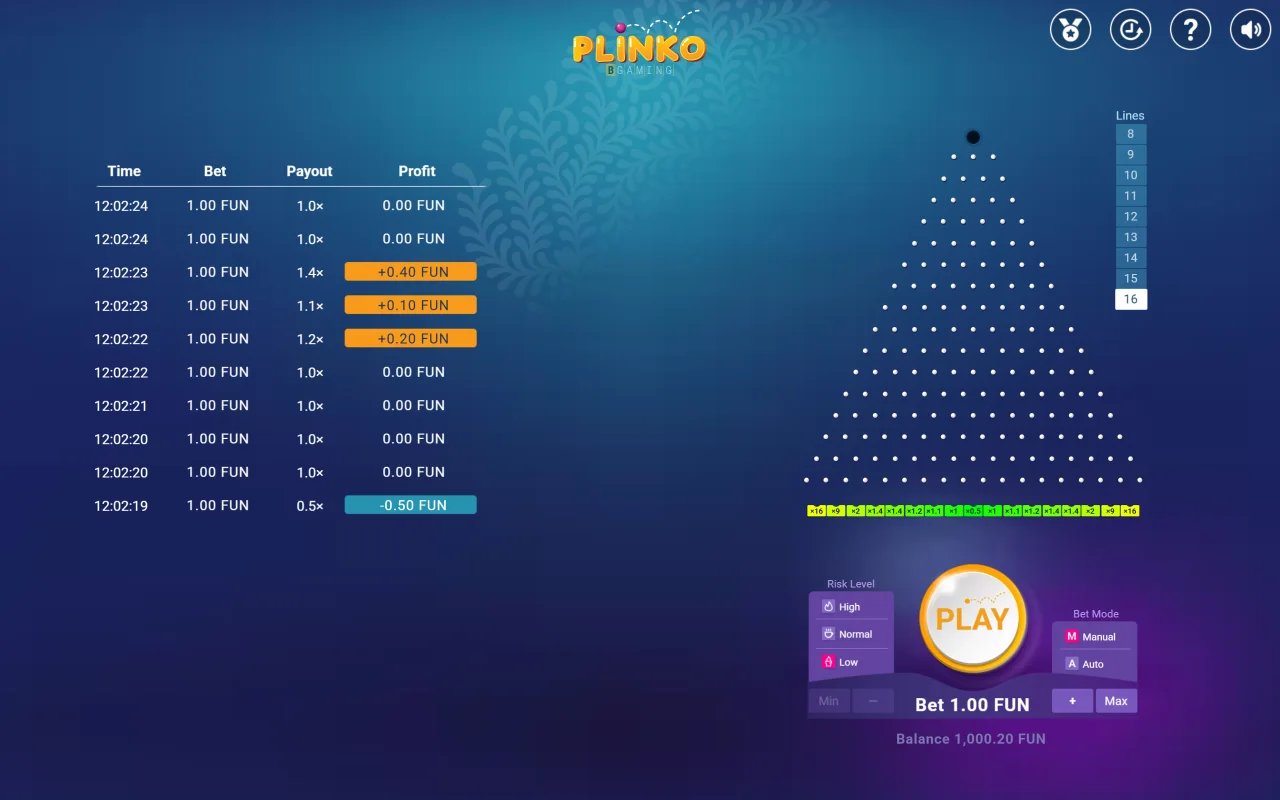
The board is a triangle of pegs. You drop a ball from the top, it bounces left or right at each peg it meets, and it eventually settles into one of the pockets along the bottom edge. Each pocket carries a multiplier. Pockets near the centre carry small multipliers, often below 1x, and the multipliers grow toward the outer edges, where the rare big numbers sit. The ball has no memory: every drop is an independent server-settled event, and the path you watch is an animation of an outcome that was already determined when the drop was accepted.
With 16 rows selected, the ball makes sixteen left-or-right decisions on the way down. That is why the edge pockets are so rare. Reaching the far left or far right pocket requires sixteen consecutive bounces in the same direction. That is a probability of 1 in 65536 for one specific edge, or 1 in 32768 for either edge. Fewer rows make the edges less extreme but more reachable: with 12 rows the either-edge probability is 1 in 2048, and with 8 rows it is 1 in 128. Understanding this shape, many small centre outcomes and rare large edge outcomes, is the foundation for everything else in this guide.
Identifying the provider and version before trusting a payout table
Every payout table, odds figure and strategy result on this site refers to the BGaming Original Plinko with 16 rows and the Low, Normal and High risk options described above. Before applying any of it, open the info panel of the game you are actually playing and check three things: the provider name, the available row counts, and the centre and edge multipliers at each risk level. If the centre pocket on Normal is not 0.3x, or the High edge is not 1000x, you are playing a different version and the numbers here do not transfer.
Dutch players have asked which Plinko variant they are actually playing. The Dutch regulator Kansspelautoriteit reported removing 20 illegal gambling apps from stores since the start of 2025. Some of those apps used Plinko-style advertising to redirect users to illegal sites. An app with Plinko in the name is not automatically the game described here, and a public BGaming demo is not evidence that the same game is offered through a Dutch licensed operator. Availability through any operator is unverified; the commercial play button on this site is a separate affiliate element, and this guide’s job is to make sure you know what you are looking at before you ever consider it.
Can you win Plinko by aiming at the centre?
In a physical Plinko board, release position is a real input. In the BGaming demo used here, the controls let you choose the stake, rows and risk; they do not let you drag the ball to a chosen release point. Advice about standing in the centre on television therefore does not describe a control you can use in this game.
The centre also has a different purpose in the payout table. On our 16-row high-risk board it pays 0.2×, so a 10-credit stake returns 2 and loses 8. More centre hits would not mean more profit. Read the actual multipliers before importing a strategy from a television clip, a physics demonstration or another app.
For ‘how to win’ questions, separate a single profitable drop from a profitable complete session. A 2× return doubles the stake returned on that drop; it does not undo all previous losses. The stake and risk examples show the calculation, and the full strategy curves include the losing intervals.
Stakes and controls
Choosing rows, risk and stake
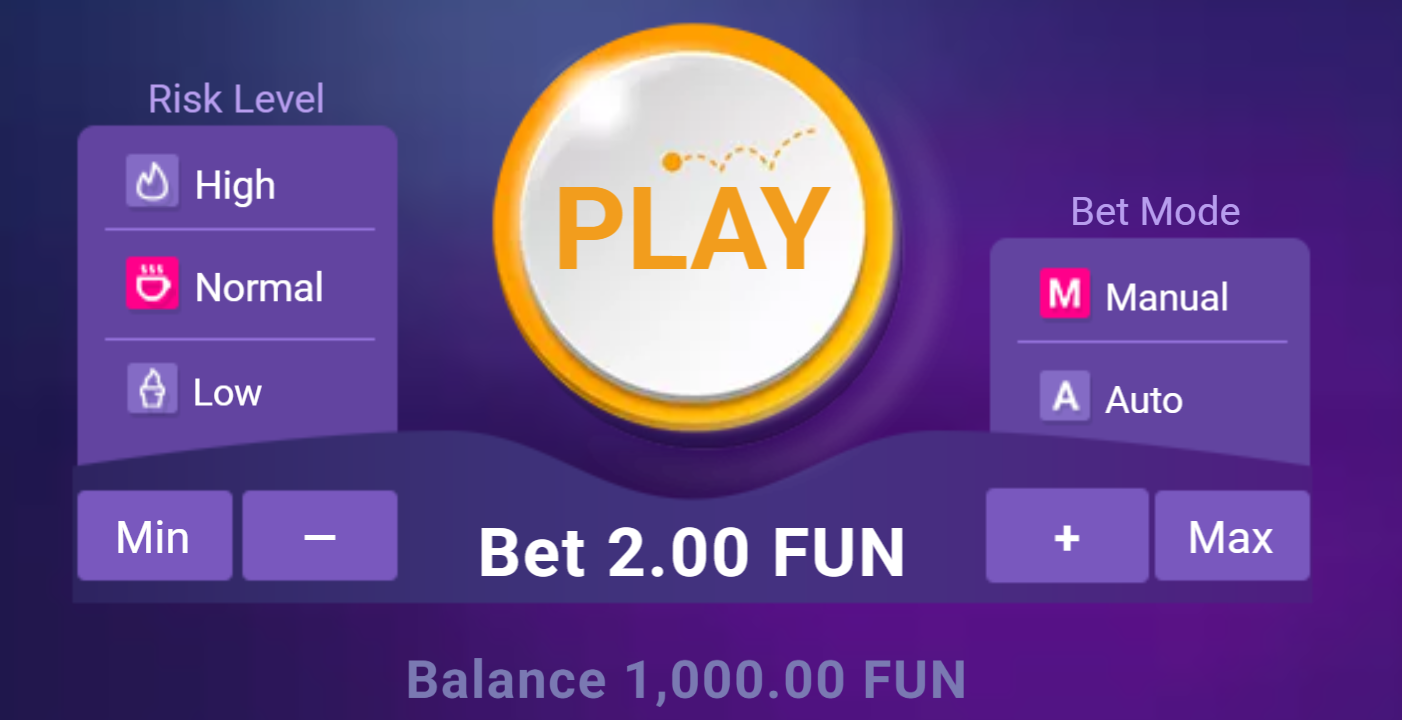
Before any drop you set three things. First, rows: the number of peg rows the ball passes through, up to 16 in this version. More rows mean more pockets, wider spread between centre and edge multipliers, and rarer extreme outcomes. Second, risk: Low, Normal (shown as medium in some descriptions of the interface) or High. Risk reshapes the multiplier row. Low risk softens the centre penalty and shrinks the top prizes; High risk makes the centre harsher (0.2x at the middle pocket) but puts 1000x on the edge. Third, stake: the single stake control sets how many FUN credits each drop costs.
There is exactly one stake control per drop in this game. If you have seen crash-style games with two betting panels side by side, that layout does not exist here. You place one stake per drop. There is no second panel to confuse with a balance display or an auto-cashout field. The stake is deducted when the drop is accepted, and the payout is credited when the ball settles. A sensible beginner starting point is the fixed 1 FUN stake used throughout our test protocol, on 16 rows, at whichever risk level you want to learn first. The settings guide walks through each control with annotated screens.
- Rows: up to 16; more rows widen the gap between centre and edge payouts.
- Risk: Low, Normal or High; changes the whole multiplier row, not just the top prize.
- Stake: one control, charged per drop, credited back with the multiplier applied on settlement.
Placing your first drop and reading the settlement
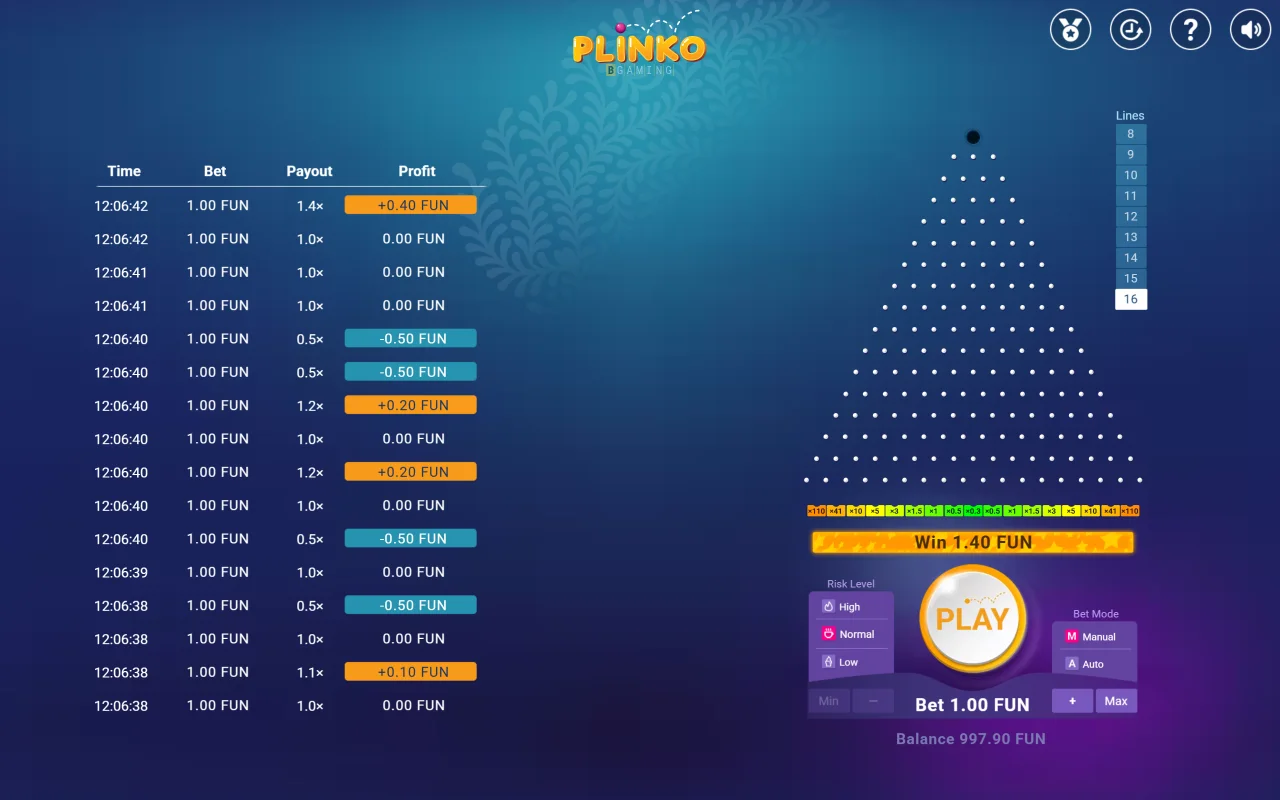
In Manual mode you press the play button once and exactly one ball drops. Watch it fall, then look at the bottom row: the pocket where the ball comes to rest is the settled pocket, and its multiplier is applied to your stake. The game also flashes the won amount, but the habit worth building is to read the pocket multiplier yourself and verify the arithmetic, because that is what protects you from misreading partial returns as wins.
A settlement is complete when the ball has stopped in a pocket and the credits have been added back to your balance. During fast play, especially in Auto mode, you may see several balls animating at once. Those overlapping animations are not unsettled bets waiting for your interpretation; each one was settled server-side the moment it was accepted, and the animation is just catching up. Your balance history, not the visual state of the board, is the source of truth for what you have actually won or lost.
Manual mode, Auto mode and what the animations mean
Manual mode gives you one drop per button press, full control over pace, and time to record each result. This is the mode to use while learning and while running any structured practice, because you can pause, change risk or stake between drops, and check every settlement against your worksheet.
Auto mode fires a chosen number of drops in sequence at the current settings. It is useful for gathering volume quickly, but it changes nothing about the odds, and it makes it easier to lose track of individual settlements. Remember the distinction from earlier: each Auto drop is an independent completed server settlement, and the overlapping ball animations are cosmetic. If you use Auto to test a staking plan, set the drop count modestly, watch the balance rather than the board, and reconcile the final balance against the number of drops and their multipliers afterwards.
RTP and payouts
Calculating stake, returned credits and net result
The arithmetic of one drop has three numbers. Stake: what you paid. Returned credits: stake multiplied by the pocket multiplier. Net result: returned credits minus stake. A net below zero is a loss, even if you got credits back; a net above zero is a profit; a net of exactly zero is a break-even. Partial returns are the defining feature of Plinko: most centre pockets pay less than 1x, so you receive credits back and still lose money on the drop. This is why any strategy that assumes a loss means losing the whole stake, such as a classic Martingale doubling to recover a full loss, is built on a wrong assumption for this game.
Worked examples at a 2 FUN stake make this concrete. The ball settles in a 0.2x pocket: returned credits are 2 x 0.2 = 0.4 FUN, net result is 0.4 - 2 = -1.6 FUN, a loss of 1.6. The ball settles at 0.5x: returned 2 x 0.5 = 1 FUN, net -1 FUN. At exactly 1x: returned 2 FUN, net 0, a break-even that holds your position in any progression. At 5x: returned 2 x 5 = 10 FUN, net +8 FUN, a clear profit. Note that in a hypothetical EUR framing at, say, 2 EUR per drop, the same multipliers produce the same shape of result; the recorded credits in this game remain FUN regardless.
- 0.2x at 2 FUN: 0.4 FUN returned, net -1.6 FUN (loss despite a partial return).
- 0.5x at 2 FUN: 1 FUN returned, net -1 FUN (half back, still a loss).
- 1x at 2 FUN: 2 FUN returned, net 0 (break-even, progression holds).
- 5x at 2 FUN: 10 FUN returned, net +8 FUN (profit).
Practice and examples
A first-ten-drop practice worksheet
The fastest way to become fluent is a structured first ten drops in the demo version. Use 16 rows, Normal risk, and a fixed 1 FUN stake. For each drop, write down five things before pressing the button again: the drop number, the pocket multiplier where the ball settled, the returned credits, the net result, and your running balance. Ten rows of this table take a few minutes and teach you more than an hour of unrecorded clicking.
After drop ten, answer three questions from your own rows. How many drops returned less than the stake? What was the single best and worst net? What is your total net across all ten, computed as final balance minus starting balance, and does it match the sum of your per-drop net column? If the two totals disagree, you misread a settlement somewhere, which is exactly the skill this worksheet trains. Only after you can fill this in accurately should you move on to comparing risk levels or testing any staking plan from the strategy overview.
- Columns: drop number, pocket multiplier, returned credits, net result, running balance.
- Fixed settings: 16 rows, Normal risk, 1 FUN stake, Manual mode.
- Cross-check: sum of net results must equal final balance minus starting balance.
Where to go after your first session
Once you can place a drop, identify the settled pocket and compute the net result without hesitation, the natural next steps are comparative. Run the same ten-drop worksheet at Low and at High risk and compare how the centre pockets behave; the 0.5x Low centre versus the 0.2x High centre changes how a session feels even before any edge pocket appears. Then explore the structured material: the full strategy catalogue covers fixed stake, percentage of bank, Martingale and its capped variant, D’Alembert, Fibonacci, Paroli, 1-3-2-6, stop-loss and take-profit limits, and restart behaviour, all defined against the partial-return arithmetic you learned here.
For hands-on experimentation, the Plinko simulator lets you run large numbers of drops at any configuration without touching your balance, which is the right environment for questions like how long you might wait for an edge pocket at 16 rows. When you want measured results rather than theory, the evidence module publishes the numeric outcomes of our own recorded protocol of 1000 drops per risk level, exactly as supplied. None of this promises that any approach wins every time; it gives you the controls, the arithmetic and the recorded data to judge each idea yourself.
Mobile play
Playing on a phone or tablet
The same game runs in a mobile browser with touch controls. The layout compresses: the board takes most of the screen, and the rows, risk and stake controls sit in a collapsible panel, usually below or beside the board. Tap to open the panel, set your three controls, then tap the play button for each Manual drop. We do not claim to have tested specific devices, so treat this as a description of the standard interface rather than a device review, and confirm the layout on your own screen in the demo before staking anything.
Two mobile habits matter. First, because the controls collapse, verify your stake and risk after reopening the panel; a session that resumes with different settings than you remember is a common beginner error. Second, the smaller board makes pocket labels harder to read during fast animations, so prefer Manual mode on mobile until you can identify the settled pocket confidently at a glance.
Plinko questions answered
How do I place one drop in BGaming Plinko?
Set rows (up to 16), choose Low, Normal or High risk, set your stake in the single stake control, and press the play button once in Manual mode. The ball drops, settles in a pocket, and that pocket’s multiplier is applied to your stake.
What does a 0.5x pocket mean for my balance?
It is a partial return. At a 2 FUN stake you get 1 FUN back, a net loss of 1 FUN. Any multiplier below 1x returns credits but still loses money on the drop.
Is there a second betting panel like in crash games?
No. This Plinko has one stake control per drop. There are no dual panels, so the stake field cannot be confused with a second bet or an auto-cashout setting.
Do overlapping ball animations in Auto mode mean unsettled bets?
No. Every drop is settled server-side when accepted. Overlapping animations are cosmetic; your balance history shows the actual completed settlements.
Does restarting after a stop limit change my balance?
Restarting resets only the cycle reference of a staking plan. Your remaining bank and all subsequent paid drops are unaffected by the restart itself.
Is a Plinko-named app the same as the BGaming demo?
Not necessarily. Check the provider name, row counts and multiplier row in the game info panel. The Dutch regulator has removed illegal apps that used Plinko-style advertising, so identity checks matter.