Rows and risk
What the Best Plinko Settings Actually Mean
There is no single best Plinko configuration, because every setting trades one thing against another. In BGaming Original Plinko, the three decisions you control are the number of rows (8 to 16), the risk level (Low, Normal or High), and your stake per drop. Rows change the shape of the board and the number of possible landing pockets. Risk changes the multipliers printed on those pockets. Stake changes only the size of each result, never its likelihood. Understanding that division of labour is the foundation of every sensible settings choice.
A common misunderstanding is that switching to High risk makes the ball more likely to travel to the edges. It does not. With the row count fixed, the ball’s path through the pegs follows the same binomial-style distribution regardless of risk mode. What High risk does is reprint the payout strip: the centre pockets pay less and the outer pockets pay far more. So when you change risk, you are changing the payoffs attached to outcomes, not the outcomes themselves. Keep that sentence in mind whenever someone claims a setting makes big pockets easier to hit.
Before touching any control, decide which of three measurable goals you are pursuing: frequent positive drops, lower drawdown across a session, or exposure to rare large payouts. Each goal points to a different region of the settings space, and none of them can be promised by any configuration. The rest of this article shows how to translate each goal into concrete settings and how to test your choice properly in the free Plinko demo before drawing conclusions.
Row Count: What 8 to 16 Rows Changes
Rows determine how many peg lines the ball crosses and therefore how many pockets exist at the bottom. More rows mean more pockets, a wider spread of possible outcomes, and much longer odds on the extreme edges. The supplied mathematics makes this concrete: at 16 rows the probability of landing on one specific outer edge is 1 in 65,536, and on either edge combined it is 1 in 32,768. Drop to 12 rows and either edge improves to 1 in 2,048. At 8 rows it is 1 in 128. The board geometry, not the risk setting, controls these figures.
This has a practical consequence for goal-setting. If your measurable goal is rare payout exposure, fewer rows make the extreme pockets dramatically more reachable per drop, while more rows stretch the waiting time enormously. The general formula for the chance of seeing at least one edge hit in N drops is 1 minus (1 minus p) to the power N. At 16 rows, even a thousand drops leave the either-edge event unlikely; at 8 rows, a few hundred drops make it plausible. Neither outcome is guaranteed, but the arithmetic tells you which board matches your patience and sample size.
Whatever the row count, results cluster near the centre. With 16 rows, the overwhelming majority of drops settle in the middle pockets, so the centre multiplier matters far more to your session than the headline edge multiplier. Choose your row count first, because it defines the probability skeleton that risk settings then decorate with payouts.
Risk Levels: Repricing the Same Landings
The three risk modes, Low, Normal (shown as Normal in the interface) and High, keep the board identical and reprint the multipliers. The supplied centre multipliers illustrate the trade clearly: at the centre pocket, Low pays 0.5 times stake, Normal pays 0.3, and High pays 0.2. Meanwhile the High risk edge multiplier reaches 1000 times stake. Moving from Low to High therefore shrinks the payout on the drops you will see most often, in exchange for enlarging the payout on drops you may never see in a session.
Partial returns are the key concept here. A payout below your stake is still a loss even though credits come back. On High risk, a centre drop returns only a fifth of your stake, so a long run of centre landings erodes a balance quickly despite the constant trickle of returns. On Low risk, the same centre-heavy run returns half your stake each time, which slows the decline but does not reverse it. Frequent positive drops, in the strict sense of payouts above stake, require landing outside the centre band on any risk level.
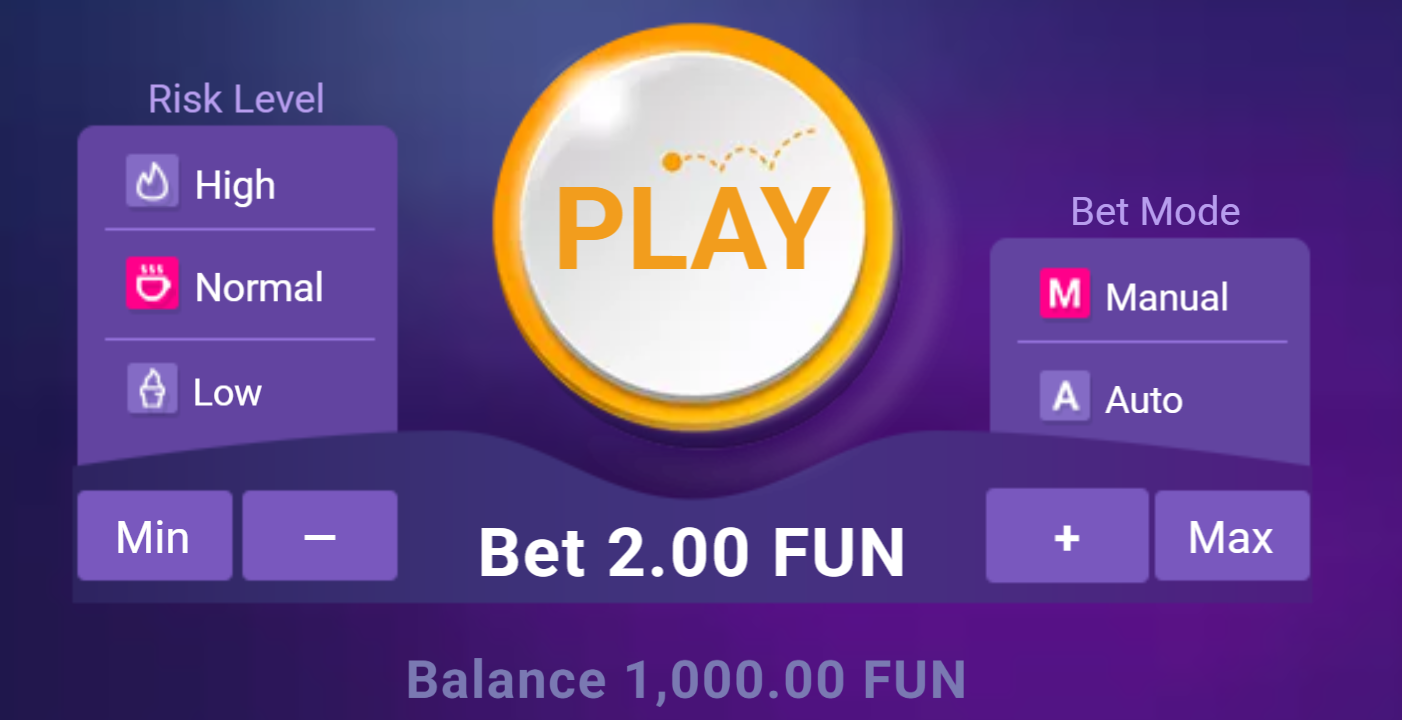
Map the modes to goals this way. Frequent modest results and lower drawdown point toward Low risk with more rows. Rare payout exposure points toward High risk, with the row count deciding how rare. Normal sits between, with a harsher centre penalty than Low but without the extreme edge pricing of High. None of these modes alters where the ball lands; they only decide what each landing is worth. For a deeper look at how the multipliers distribute, see the Plinko odds and multiplier breakdown.
Stakes and controls
Desktop and Mobile Control Walkthrough
On desktop, the BGaming Original Plinko interface places the board centrally with the controls to one side. The row selector steps through 8 to 16 rows; each click rebuilds the board and the payout strip. Below it, three risk buttons switch between Low, Normal and High, reprinting the multipliers instantly. The stake field accepts direct typing or stepper clicks, and the play button drops one ball per press. An autoplay panel, where present, lets you queue a number of drops and attach stop conditions, which is valuable for structured testing because it removes your finger from the rhythm.
On mobile the same controls stack vertically, usually beneath or beside a compressed board. The row and risk controls behave identically, but the smaller payout strip can be harder to read, so rotate to landscape or zoom before recording any multipliers for a test. Autoplay is especially useful on mobile because rapid manual tapping invites miscounted samples. Whatever the device, set rows first, then risk, then stake, then drop, and confirm the strip after every change.
For testing purposes, manual single drops with a tally sheet beat autoplay when you are learning, because you feel each partial return. Switch to autoplay only once your counting method is reliable, and always verify the settled drop count against your plan. The full Plinko settings reference mirrors this order of operations.
Bankroll and limits
Reading the Payout Strip Before You Drop
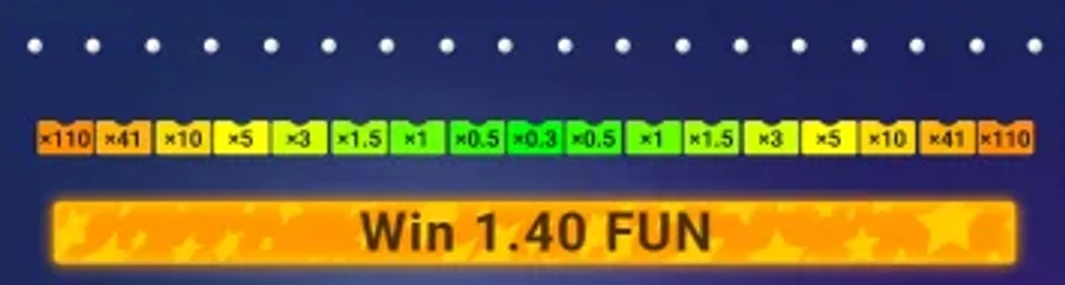
The payout strip along the bottom of the board is the single most informative element on the screen, and it deserves a slow read before every session. It lists, left to right, the multiplier applied to your stake for each pocket. The strip is symmetric: the highest values sit at both outer edges, and values step down toward the centre. When you change rows, the number of pockets changes. When you change risk, the numbers change. When you change stake, the strip stays the same and only the credit arithmetic scales.
A useful habit is to locate the break-even pockets, the ones paying exactly 1 times stake, and count how many pockets pay above it. How many drops end as partial losses depends on the risk mode. On a 16-row High board the five centre pockets pay only 0.2 times stake and together absorb most drops. On a 16-row Low board only the single centre pocket pays below stake. Session-level thinking therefore matters more than drop-level thinking. If the strip you see does not match a table you saved earlier, stop and check which version and risk mode you are actually playing before trusting any numbers.
Also note the input order the game applies: you set rows and risk first, then stake, then press play. Changing risk mid-session reprints the strip immediately, so any mental notes about which pockets are profitable must be refreshed. Treat the strip as a live document, not a fixed reference.
Choosing One Measurable Goal
Vague goals produce vague settings. A measurable goal names a metric, a sample size and a pass condition before the first drop. The three goals that cover almost every player’s intent are frequent positive drops, lower drawdown, and rare payout exposure. Each is measurable with nothing more than a notebook or spreadsheet and the game’s own history.
Frequent positive drops means maximising the share of drops that pay more than stake. A concrete target might be: over 200 drops at 1 FUN, record how many pay above 1 FUN, and compare Low versus Normal risk at 16 rows. Lower drawdown means minimising the worst peak-to-trough balance decline during a fixed session. A concrete target: over 500 drops at 1 FUN, record the largest drop from a running high, and compare 8-row Low against 16-row Low. Rare payout exposure means maximising the probability of at least one hit above a chosen multiplier within a budget of drops. You can estimate that with the 1 minus (1 minus p) to the power N formula and then observe it in practice.

Write the goal down with its numbers before playing. If you cannot state what you will count and over how many drops, you are not testing a setting, you are just playing. The Plinko simulator approach is built around exactly this discipline of pre-registered counting.
- Frequent positive drops: count payouts strictly above stake over a fixed sample.
- Lower drawdown: record the worst balance decline from a running peak.
- Rare payout exposure: estimate edge-hit probability, then observe over a set drop budget.
- One goal per test; never judge a setting on a goal it was not chosen for.
Worked Settings Examples
Example one: the drawdown minimiser. Choose 16 rows, Low risk, 1 FUN per drop, 500 drops. The centre pays 0.5 FUN, so the most common outcome returns half the stake. Track the running balance from a 100 FUN starting point in credits and note the lowest point relative to the last peak. Repeat with Normal risk, same rows, same stake. Because Normal’s centre pays only 0.3, the same landing pattern drains faster; the comparison quantifies exactly how much the risk reprint costs you on centre-heavy boards.
Example two: the rare-payout seeker. Choose 8 rows, High risk, 1 FUN per drop. Either edge at 8 rows is a 1 in 128 event, so over 384 drops the chance of at least one edge hit is 1 minus (127/128) to the power 384, roughly 95 percent on paper, though never guaranteed. Compare with 16 rows, where the same budget against 1 in 32,768 odds makes an edge hit a long shot. This example shows why the row count, not the risk button, governs waiting time for extremes.
Example three: the frequent-positive tester. Choose 12 rows, Normal risk, 1 FUN, 200 drops, and count payouts strictly above 1 FUN. Then repeat at Low risk. Low will typically produce more above-stake returns because its mid-band multipliers are gentler, but each such session is a sample, not a law. Record both, and let your own counts, not intuition, pick the mode for this goal. All arithmetic here is hypothetical; recorded credits in play remain FUN.
Staking Plans Interact with Settings
Settings and staking plans are separate layers, and mixing them carelessly breaks both. The supplied rule semantics show why partial returns matter so much here. Martingale doubles after a loss and resets after a profitable result. But in Plinko a loss means a payout below stake, and partial payouts make the classic 2x recovery assumption invalid. Doubling after a 0.5x return does not recover the prior stake. Capped Martingale in this study runs stakes of 1, 2, 4, 8 and 16 FUN. It resets after the fifth consecutive net loss or any net-positive result. A bad run can therefore expose 31 FUN across five bets before returns. The step cap limits sequence length but is not a guaranteed loss cap.
Percentage staking starts at 1 percent of the current bank, so at a 1000 bank it stakes 10, not 1, and the stake drifts as the bank moves. D’Alembert adds one unit after a loss and subtracts one after a profit, never below base. Fibonacci advances after a loss and steps back two after a profit. Paroli doubles after wins and resets after three winning steps or any loss, and 1-3-2-6 progresses after wins and resets after a loss. Each plan defines profit as a payout above stake and break-even as holding the progression, so the risk mode’s centre multiplier directly changes how often each plan advances.
Stop limits check settled net against minus 20 and plus 20 and can overshoot, because a single drop can carry the balance past the line before the check runs. Restart after a stop resets only the cycle reference; it keeps the remaining bank and pays for all subsequent drops, so restarting does not restore your balance. Small banks and stake caps deserve their own sensitivity test, since a 100 FUN ordinary bank with a 100 FUN cap behaves very differently from a 1000 FUN bank under the same plan. See the strategy test results module for how these plans are evaluated on recorded samples.

How can you avoid overspending while testing Plinko strategies?
Set the total amount you can afford to lose before the session, including every possible restart. In a hypothetical 100-credit budget, five separate 20-credit allowances still expose 100 credits. Resetting the session counter after each loss does not restore the money. Keep one cumulative balance alongside the session balance.
For a clearer demo comparison, use a fixed stake, place one drop at a time and stop at the first of your time, drop-count or loss limits. Wait for all accepted drops to settle. A stop-loss checked after a result may overshoot its threshold; it cannot cancel stakes already accepted. The simulator’s stop controls apply to the model, not to an external casino account.
A 1% stake from a 1,000-credit starting bank is 10 credits. A lower percentage reduces the amount exposed per drop; it does not improve the probability of the next pocket. Use the bankroll simulator to compare drawdown and completed bets before choosing a practice configuration.
Compare and test
Why Reusing Another Version’s Table Fails
Dutch players regularly ask which Plinko variant they are actually playing, and the question matters more than it first appears. Different providers and even different builds print different payout strips for the same nominal row count and risk label. A saved table from one game, applied to another, produces confidently wrong expectations: break-even pockets shift, centre penalties differ, and the edge multipliers may not exist at all. Before reusing any payout table, confirm the provider identity, the row count and the risk mode on the live strip in front of you.
The same caution applies to apps and advertisements. The Dutch regulator, the Kansspelautoriteit, reported removing 20 illegal gambling apps from stores since the start of 2025 in its 7 April 2025 notice, some of which used Plinko-style advertising to redirect users to illegal sites. An app with Plinko in the name is not necessarily the game whose table you studied, and a public demo does not confirm availability through a Dutch licensed operator. Verify identity on the screen, not in the app title.
Within one game, table reuse fails in a subtler way: a strip copied at High risk is meaningless at Low risk, and a 12-row strip cannot be stretched to 16 rows. Treat every combination of version, rows and risk as its own document. When in doubt, re-read the strip rather than trusting memory.
Testing One Change at a Time
The fastest way to learn nothing from a session is to change two things at once. If you move from 8-row Low to 16-row High and your results differ, you cannot attribute the difference to rows or to risk. The correct method is a chain of paired tests: hold rows and stake constant, change only risk, run your pre-registered sample, record the metric, then reset and change only rows for the next pair.
A practical protocol: fix the stake at 1 FUN for every test so results stay comparable. Use identical sample sizes per arm, for example 200 or 500 drops. Record the metric your goal defines, nothing else. Between arms, write down the exact configuration so a later session can replicate it. If a result looks surprising, rerun the arm before concluding anything, because small samples in a centre-heavy game can mislead.
This discipline also protects you from pattern-hunting. Structured hypotheses such as A100, B50, B100 and C25, which look at previous pocket distances or centre scarcity before placing one larger stake among ordinary paid drops, are testable ideas, not edges. A100, for instance, uses only earlier paid outcomes to decide when to place one larger stake among ordinary paid drops. Such patterns deserve the same one-change testing on fresh data as any settings choice, and frozen historical patterns must be re-validated rather than assumed to persist.
Notes for Players in the Netherlands
For Dutch readers, two practical points stand out. First, game identity: forum discussions about which Plinko version is preferable only make sense once you have confirmed the provider and read the live payout strip, because variant names circulate loosely. Second, availability: a public BGaming demo is not evidence that the same game is offered through a Dutch licensed operator, and the regulator’s app removals show that Plinko branding is also used by illegal offerings. Treat any commercial play option as unverified until you check it yourself.

Everything in this guide uses FUN credits and hypothetical arithmetic. If you ever translate session sizes into EUR for budgeting, do it as a separate, clearly hypothetical exercise, and never let a euro figure disguise the fact that no setting or plan guarantees a positive outcome.
Putting Your Configuration Together
A complete configuration statement reads like this: 12 rows, Low risk, 1 FUN flat stake, 300 drops, goal is drawdown under 30 FUN from the running peak, pass condition recorded in advance. That single sentence contains the board, the pricing, the stake layer, the sample and the metric. If any element is missing, the test is unfinished before it starts.
Change exactly one element per follow-up test. Move to Normal risk and rerun. Then to 16 rows and rerun. Build a small grid of results that you produced yourself, on the version you actually play, and your settings choice becomes evidence-based rather than folklore-based. The Plinko strategy hub links the supporting modules for odds, results and simulation so each layer of this guide can be checked independently.
For concreteness, on our recorded 3000-drop FUN sample, Capped Martingale (base 1 FUN, factor 2, max 4 steps, 1000 FUN bank, 100 FUN cap) finished the 1000-drop High-risk arm up 725.6 FUN. Its worst drawdown was 478.8 FUN and its maximum stake was 16 FUN. The same rule lost 9.6 FUN on the Low-risk arm of the same sample. That rule was picked as the best of 14 predefined rules only after all outcomes on the full history had been seen. It also ran on FUN demo credits. So treat it as a concrete, interesting historical parameter set with real exposure, not as a promise of future profit. Finally, accept what settings cannot do. No row count, risk mode or stake plan changes the centre-heavy shape of the landing distribution or promises profit. What good settings do is align the game’s payouts with a goal you can measure, at a cost you can see, over a sample you can count. That is the honest ceiling of Plinko strategy, and reaching it puts you ahead of almost every untested opinion you will read.
Do the best Plinko settings on Stake or 1xBet apply here?
An operator name is not a payout table. Stake Originals Plinko and BGaming Original Plinko are different products. A search for ‘how to win Plinko in 1xBet’ also does not identify which provider, table or build is being played. Our 3,000-drop sample does not test either operator’s cash account or every game in its lobby.
Before comparing settings, match the provider, row count, risk level and every pocket multiplier. At 16 rows, the BGaming high-risk table used here pays 0.2× in the centre. A 5-credit drop there returns 1 credit and loses 4. If another board has a different centre return, the same loss progression produces different balances. Use the BGaming practice demo to identify this version; do not label these results as a tested Stake or 1xBet strategy.
Reddit strategies
Best Plinko strategy on Reddit: which claims are worth testing?
The discussions we read contain competing suggestions, not an agreed winning system. One r/stakeus post raises the stake after roughly 25 returns of 0.2× in 30 drops. Other comments favour bursts of 5–8 balls, seed changes or particular times of the hour. These are player reports. A memorable winning session does not establish which part of the routine caused the result.
Separate the proposal into a trigger, stake, reset and stopping rule. “Raise after many low returns” is too vague to reproduce. Write down exactly how many previous drops count and when the higher stake ends. Then compare every completed bet with a fixed-stake replay on the same sequence. Our historical results and strategy curves provide that comparison for the rules we actually tested; they are not a test of every Reddit claim.
The thread claiming a million Plinko drops is also a useful reminder to inspect the evidence behind a large sample count. Replies question its reporting. We have not independently verified that experiment and do not use its casino ranking as a measured result. A useful comparison needs identifiable game versions, full ordered results, stakes and a reproducible calculation—not just a headline sample size.
For the concrete calculations, see tap bursts, stake increases and seed claims. For physical-board advice about aiming at the centre, use the version and controls guide. A release position on a television board is not a steering control in this browser demo.
Do bursts of 5–8 Plinko balls change the result?
A comment in the Plinko strategy discussion proposes 16 rows, high risk and short bursts at 0.44 or 0.88 per ball. It also changes seeds and switches games. That bundles several decisions together, so a reported win cannot tell us whether the tapping rhythm helped.
The immediate calculation is exposure: five accepted bets at 0.44 commit 2.20 credits; eight at 0.88 commit 7.04. Those stakes remain at risk while the balls settle. A pause can help you see the balance and avoid sending another batch accidentally. It is not evidence that the next pocket becomes more favourable.
Replaying an unchanged result sequence with the same stakes gives the same net total whether you display it in groups of five or eight. That is an accounting fact, not a live experiment on the provider’s timing. To compare pacing itself, you would need a separate recorded test, a fixed protocol and all accepted bets. Our current corpus does not establish a timing advantage.
Raise the stake after 25 low returns: what is the actual rule?
One player describes increasing from 0.25 to 0.50 after about 25 results of 0.2× in about 30 drops. Later stake changes and resets are described less precisely. We have not reproduced that player’s account or verified the reported profit. A repeatable adaptation would have to specify an exact lookback, threshold, higher stake and reset before testing.
At 0.2×, a 0.25-credit stake returns 0.05 and loses 0.20. A 0.50-credit stake returns 0.10 and loses 0.40. The increase doubles both the possible payout and the amount lost on that outcome. It does not itself change the next pocket’s probability. In an independent-drop model, a run of low returns does not make a higher return due.
A useful test keeps the fixed-stake comparison, every losing interval and any bankroll stop. Our tested historical strategies include positive examples with their complete drawdowns. A profit found after inspecting a sequence is a reason to test the frozen settings on new data, not a verified forecast.
Do seed changes every 500 drops or end-of-hour bets help?
The 1,000× discussion includes suggestions to change seeds within 500 drops and play near the end of an hour. Other replies describe different routines and losses. These reports do not isolate a repeatable advantage.
In the published Stake fairness implementation, the random calculation uses server and client seeds plus a nonce and cursor. A seed change changes the sequence; it does not reveal which new sequence will be profitable. Wall-clock minute is not an input in that documented calculation. This statement concerns that implementation, not every product named Plinko.
Our BGaming sample is not a controlled trial of seed rotation or hour-of-day effects. We therefore do not label either routine as tested. For a repeatable comparison, change the stake rule while keeping the recorded results fixed; use a fresh recorded sample to evaluate a rule chosen in advance.
Plinko questions answered
Does High risk make edge pockets more likely in Plinko?
No. With rows fixed, the landing distribution is identical across risk levels. High risk only reprints the payout strip, paying less in the centre and more at the edges.
How many rows should I choose for a chance at the biggest multipliers?
Fewer rows make extreme pockets more reachable per drop: either edge is 1 in 128 at 8 rows versus 1 in 32,768 at 16 rows. More rows mean longer waits for the same extremes.
Is a payout below my stake still a loss?
Yes. Partial returns such as 0.5x or 0.2x return credits but still reduce your balance. Only payouts above stake count as profit for staking-plan purposes.
Does restarting after a stop limit restore my balance?
No. Restart resets only the cycle reference. Your remaining bank carries over and all subsequent drops are paid from it.
Can I reuse a payout table from another Plinko version?
No. Strips differ by provider, row count and risk mode. Always confirm the game identity and read the live strip before trusting any saved numbers.
What is the safest way to compare two settings?
Hold stake and sample size constant, change exactly one variable, run identical drop counts, and record only the metric your pre-set goal defines.